
I received 0%.
It was the score I received from the recent student survey rate. Realizing no one from my class had filled out the student survey first shocked me, and then the initial shock turned into an embarrassment and a question.
“Was I such a great instructor who does not need any feedback or such a bad one who does not even deserve a negative assessment?”
Not a single soul from my class bothered to click. It was a revelation that demanded action.

With a determination fueled by the sting of this unexpected silence, I embarked on a digital quest: google it.
As I delved into the vast Google land, my query was, “How do you make people want to fill out the survey?” As a non-survey filler myself, I knew finding the solution would not be easy.
The journey was not just about salvaging a response rate; it was an exploration of engagement, a quest for connection with my students.
Little did I know, this exploration would shape my student survey strategy and open a window into the broader implications of the 1000 true fans theory, even in the seemingly non-creative task of eliciting feedback.
.
What is the 1000 True Fans Theory?
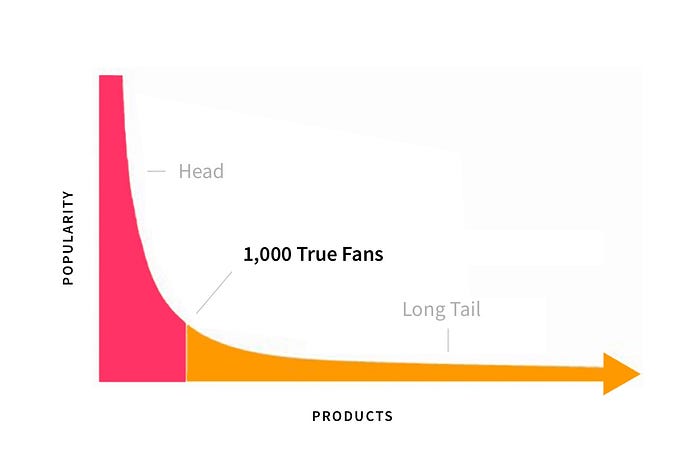
In the digital archives of 2008, Kevin Kelly, the inaugural editor at Wired Magazine, wrote a game-changing theory that sent ripples through the creative realms – the theory of “1,000 True Fans.”
His insight crystallized around a fundamental concept: the vitality of a dedicated fan base to sustain creative endeavours.
Whether you’re an author or an designer, the premise is the same – your work needs fans, not just any fans, but the genuine, ride-or-die kind.
If you are an author, your words need to resonate with a sufficient number of ardent readers who not only devour your creations but also become cheerleaders, spreading the word and, crucially, contributing to increasing book sales.
Artists/designers, too, rely on this symbiotic relationship with patrons who appreciate their work enough to purchase, commission or simply advocate within their circles.
Fast forward to our hyper social media present time, and the term “fan” has a new name: followers. Kelly’s theory resonates with today’s interconnected world, where social media platforms serve as modern amphitheatres for creative expression.
A writer’s fans might be followers eagerly awaiting each blog post, and an artist’s enthusiast could be Instagram followers captivated by every image.
The theory orbits around two critical points.
First and foremost, the creator must generate “enough content” to sustain and attend to the fan base. This isn’t a mere numbers game (although it is a vast and unavoidable portion) but a delicate mix of quality meets quantity, offering a continuous flow of material that keeps the audience engaged and invested.
The second key point is forging “direct relationships with fans.” It’s not enough to be a distant creator; instead, the magic lies in fostering a tangible connection. This involves engaging with your audience, understanding their desires, and making them an integral part of the creative journey.
In a nutshell, Kevin Kelly’s 1,000 True Fans theory isn’t just for creators; it’s a manifesto for a thriving, reciprocal relationship between people.
It’s a rallying call to create content and cultivate a community that propels the creative vision forward, ensuring that the work doesn’t merely exist but thrives in the hearts and minds of those who truly value it.
Two Fundamentals: Content and Relationship
Applying the 1,000 True Fans theory to my recent “0% to at least 50% survey rate” effort became a reflective exercise for myself and “some” of the students, using two core principles: “enough content” and “direct relationships with fans.”
Since the first class back in September, where I’ve been guiding students through the design projects, the concept of “enough content” took a unique form.
In a small class of 18 students, and with the added presence of another instructor, the intimacy of the setting provided ample opportunities for me to delve into the creative minds of each student.
I took on a dual role as both their cheerleader and antagonist of their ideas, providing design knowledge and a continuous exchange of insights and feedback that went beyond the conventional classroom communication.
This deepened understanding stemmed from a blend of regular interactions, discussions, and feedback sessions, forming a more profound engagement that resonated with the essence of Kelly’s theory.


Now, this aspect is omnipresent with the second point – direct relationships with my fans students – in the design studio classroom setting.
Every week, I had the privilege of observing and engaging with each student, witnessing the evolution of their work firsthand. This wasn’t a distant exchange but a direct, ongoing relationship that allowed me to understand their projects and the unique perspectives and motivations driving their creative endeavours.
This was particularly poignant in a class setting where the design process demanded a closeness between instructor and student, transcending the traditional boundaries of classroom settings.
Even students who missed classes occasionally found a space where their voices and visions were heard, strengthening the bonds of their creative community.
In essence, the 1,000 True Fans theory wasn’t just a theoretical framework; it became a living philosophy in the dynamic realm of the design classroom.
It illuminated the path to fostering not just students but advocates of design thinking, where the richness of content and the depth of relationships intertwined to create an environment where creativity thrived, and genuine connections blossomed.
My Experiment with 1000 True Fan Theory
To breathe life into the stagnant survey response rate, I harnessed Mr. Kelly’s wisdom, wielding the dual powers of “enough content” and “direct relationships with fans.” (aka operation 0% to min 50%)
Armed with insights, I embarked on a personalized campaign with each student.
Rather than deploying a generic plea for survey participation to the entire class, I crafted individual emails to students, weaving my personal interactions over the semester while pleading with them to fill out the survey.
Using my past student work archives of notes, I unearthed the progress and pitfalls of each student’s design journey.
This wasn’t a mass appeal; it was a bespoke engagement strategy that highlighted the unique aspects of every student’s creative process.

The emails weren’t just about surveys; they were a narrative of shared experiences, a testament to the “enough content” principle. By infusing the messages with specific details from our shared semester’s journey, I hoped to create a personal connection beyond a classroom setting.
The impact was palpable. Half of the class students responded not only to the survey but also to the personalized emails.
One standout moment revealed the profound effect of this approach. A student grappling with the challenges of her upcoming final presentation candidly shared her work difficulties.
It was a glimpse into the personal struggles beneath the surface. This story might have remained untold in the generic class communication.
This revelation underscored the potency of forging direct connections, transcending the formalities of the conventional lecture style of classroom settings.
Through this experience, I realized that connecting with my students personally was the linchpin to discovering ‘true fans’ among them.
It wasn’t just about the survey response but about fostering a genuine connection that transformed students into my advocates, turning a class into a community bound by shared experiences and a collective appreciation while working together.
In teaching, as in the creative work, the 1,000 True Fans theory proved its strength, reminding me that the essence of connection lies in nuanced personal engagement.
Final Thought
In creative pursuits, Kevin Kelly’s seminal concept of the “1,000 True Fans” in 2008 stands as a beacon illuminating the interdependent relationship between creators and their audience.
As for my recent experiment with his theory, I can attest the theory works for unoriginal, uninventive work like asking to fill out a survey. I wish I knew how I could find the “other 50%” students.:)
 Life Outside of Design Studio