
The best part about teaching has to be students, especially those I remember after they finish my courses and even after graduation.
Elza Yu is one of those memorable students I had the honour to teach. We met during the worst time, the Pandemic. As an instructor at OCAD University, I faced (literally) many students on the computer screen back in 2021, including Elza. Even squinting my eyes to see everyone on the screen, I quickly recognized her proactiveness in her learning from day one: preparation before the class, engagement during the class, and, mostly, the continuous quest to improve her work throughout the semester.
When she asked for her Architecture graduate school recommendations, I was more than ready to give the outstanding accomplishment stories to various schools she selected, including Berkeley University.
This blog post is about her account in a new setting, Berkeley Architecture School and how she navigates her graduate school life. It is her Life “inside” the Design Studios.
Written by Elza Yu
The first semester of my graduate studies has officially concluded, and I would like to share a brief reflection here.
Difference between undergraduate and graduate educations
Firstly, I’ll outline the graduate courses and then draw some comparisons between the learning atmosphere and environment here at Berkeley and my undergraduate experience, OCAD University.
Despite being at Berkeley one semester, I could truly sense the progress and pressure within the architecture department.

We mainly have four courses: History, Public Speaking, Studio, and a software-related course that complements Studio. Let me delve into History and Studio.
I must say the professor for the History class is quite engaging. He uses humorous language to introduce architects, not just focusing on their architectural works but also sharing anecdotes or life experiences during the construction process.
This teaching method provides a multidimensional impression of each architect. Apart from the mid-term and final written exams, we are required to design a manifesto, presenting strong modification guidelines for current designs.
The form of the manifesto is also self-designed and can be anything other than plain text. I chose a folding fan shape, symbolizing the transition between folded and unfolded states, akin to the transformation from paper architecture to real buildings.
Studio course and all-nighters
In our first semester studio, grades are not given in specific scores, only ‘satisfy’ (S) or ‘unsatisfy’ (U). However, students are very proactive, not hiding their design ideas to avoid professor evaluation.
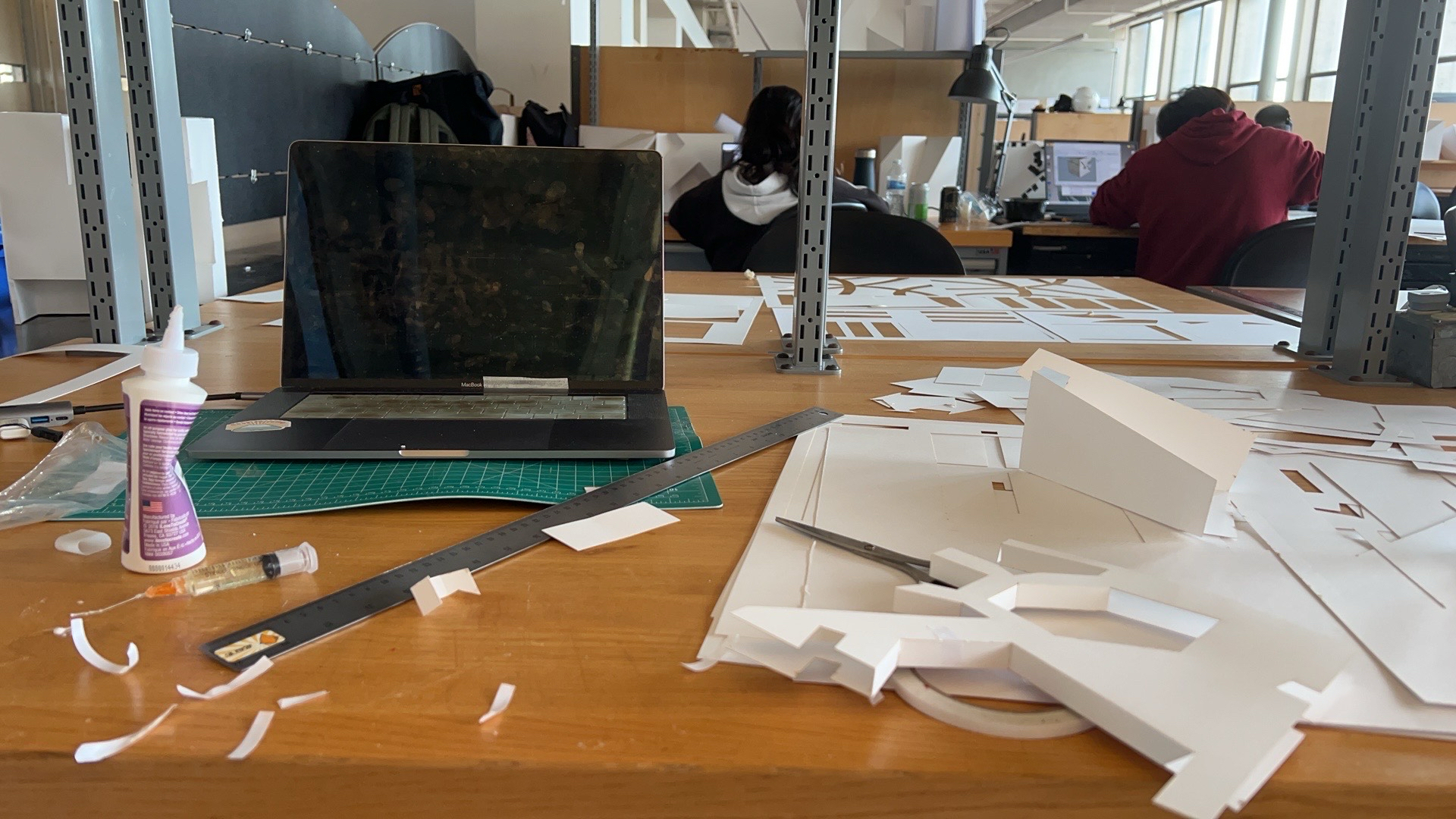
Instead, they eagerly seek the professor’s genuine feedback. Hence, the learning atmosphere at our school is quite positive. We often work overnight in the studio, and when someone completes a model, others gather around to praise the achievement, creating a sense of accomplishment.
Of course, this positive atmosphere is inseparable from academic pressure.
Our professor emphasizes that falling behind in even one class can lead to a gradual lag behind the majority, resulting in complete disconnection later.
Unlike undergrad thesis projects that take a year, in grad school, we complete site analysis, literature review, and conceptualization within a week. Our first semester focuses on the correlation between architecture and site, and the connection between architecture and landscape design.
Let the drawings speak
During the second week of studio, we start presentations, and many students experience it for the first time. Our professor advised, “You shouldn’t speak for yourself; let the drawings speak.”
So, our presentation became a ‘silent’ one, with just a few sentences followed by answering the professor’s questions about the drawings.
I agree with this perspective because there’s a phenomenon where designers often need to use words to describe a narrative, losing the ability to convey their ideas directly through design.
Regarding model making, we need to create partial models for mid-term and final projects. I experimented with a new method called double bristial, where the entire model is made of watercolor paper, and the connection between papers relies on fine glue.
Compared to my undergraduate education, Berkeley’s studio space is limited. While grad students have 24-hour access, machines become scarce during mid-term and finals. OCAD provides wood, plastic, metal studios, offering more variety. However, undergrads have 3D printing and laser cutting done by student monitors, leading to communication costs and missing hands-on opportunities.
Mastering mechanical aids in design is a basic skill in the industry.
Students fear entering the working environment only to discover a lack of matching skills. Therefore, accumulating these experiences during school is crucial.
Life at Berkeley campus
Berkeley’s campus is extensive, and I haven’t walked through it entirely.
Having a cafeteria makes me feel fortunate. After studio, I usually head to the cafeteria for a meal and then return to the studio to work on models. It’s both economical and time-saving.

In terms of the learning atmosphere, Berkeley indeed has a more intense vibe, evident in the contrast of students in the library. Of course, this is closely tied to the teaching policies and student demographics of the two schools.
Final Thoughts
In summary, my inaugural semester at Berkeley for graduate studies has been a transformative journey within the field of architecture.
The engaging courses, collaborative studio projects, and unique teaching methods have not only broadened my understanding but also cultivated a positive and dynamic learning environment.
 Life Outside of Design Studio
Coming from a structural engineering background, I found that your emphasis on the multidimensional approach to studying architects’ works in the History class resonates with me. Understanding the context and the anecdotes behind architectural creations adds depth to our appreciation of the built environment.
It’s inspiring to hear how your peers eagerly seek feedback and support each other’s achievements, fostering a sense of camaraderie and accomplishment.
It’s evident that Berkeley’s emphasis on hands-on experience and mastery of mechanical aids aligns with the industry’s demands, preparing students for the challenges of the professional world.
Thank you for sharing your insights, and I wish you continued success in your academic and professional endeavors.
LikeLike