
Getting presentation advice from non-architects is essesntial—after all, we spend most of our time convincing clients, planners, and committees who aren’t architects that our ideas work. Our guest blogger, Ketan Marballi Ph.D. a biologist turned career advisor, tells us how.
Here is his story.
The journey to pursuing a PhD
I was always interested in the impact of career choice on one’s life.
I remember giving my first “presentation” as a speech on “the choice of a career” to fellow 10th grade students in Mumbai, India. It fascinated me that your career can impact your happiness and sense of fulfilment.
I ended up pursuing a career in research. During this time, I had started giving more presentations, but I was not comfortable using PowerPoint. In fact, I still remember defending my master’s thesis using hand-written transparency slides and an old-fashioned projector. Yes, that is how old I am!

My career had hit a ceiling in India, so I decided to pursue a PhD in the states so that it would open more opportunities for me globally. I worked and studied hard and got accepted into a PhD program at UT Health in San Antonio, Texas.
Presenting in graduate school
I remember being absolutely terrified the first time I had to present a scientific paper for a class in the first year of my PhD called “colloquium”.
As an international student, my biggest worry was how I was going to fare against native English speakers and people who had way more experience using PowerPoint.
I was extremely anxious and thought of how I could make my presentation compelling. The first thing I did is think about my audience – what would they find interesting? I ended up picking a research paper on malaria, a disease that is transmitted by mosquitoes, and very common in tropical countries but not as common in the States.
To make the presentation more engaging, I added a short video on what malaria was so that it would draw the audience’s attention from the get-go. I tried to use minimal text, so the audience would pay more attention to what I was saying and practiced a bunch of times, so I knew my cues for each slide. To my surprise, I was chosen as a TA for that course for the next semester.
As a science PhD student, giving presentations started becoming second nature to me.
I had to present at weekly lab meetings, journal clubs -where we discussed scientific papers, seminar- where we presented our research, dissertation committee meetings- where we presented research progress to our committee, at conferences presenting posters and talks, and the dissertation defense.

Changing career aspirations
After I graduated, I was pretty set on being a professor, so I pursued postdoctoral training aka more independent research training. Out of interest, I started organizing career events for postdoctoral scholars as part of leadership group at UT Austin and started chatting with people in different career paths.
Then COVID happened and it really made me take a long hard look at my life. I realized my career aspirations had changed, and I wanted to pursue something where I could directly help students and postdocs. There was limited career support when I was a graduate student, so I wanted to be a career guide for future graduate students and postdocs. Having shadowed career development professionals, I was convinced this was the right path for me.
Working as a career development practitioner with Architecture students
After a year of networking and volunteering I landed my first role in career development in Toronto that eventually led me to my current role supporting engineering and architecture graduate students and postdocs with their career and professional development.
Being a researcher by training, I always start by studying the needs of the students I work with.
When I found that I was going to work with Architecture students, I felt the best way for me to understand their work would be to attend their defense presentations. I could then use what I learn to understand how their work would translate to different types of employers.
I took the initiative of attending MArch presentations and realized that Architects have a unique challenge – communicating their highly creative and technical work that is often multidisciplinary, in a way that can capture different audiences.
In addition to one-on-one advising, I also organize workshops for student professional development. I was tasked with creating a workshop on “honing your presentation skills” for Architecture students, with the hope of enticing them to enter the 3-minute thesis (3MT) competition.
I am going to share a few tips from that workshop that will hopefully help you out the next time you are preparing to give a presentation.
The different elements of giving better presentations
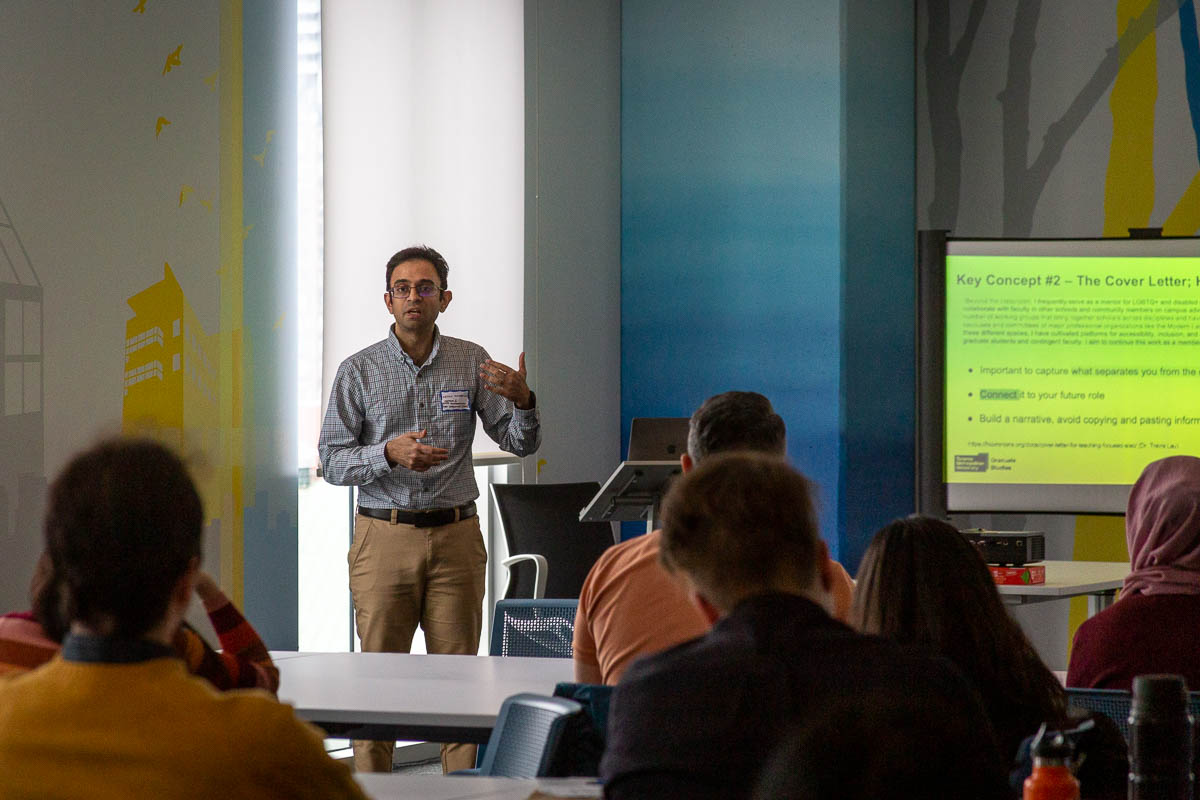
Body Language
- Plant your feet: Pay attention to your posture and try to have a comfortable stance.
- Breathe Easy: Proper breathing can help you relax and support focus.
- Eye see you: You want to make sure to evenly distribute your gaze across the audience, so that everyone feels included.
- Outfit rehearsal: Practicing in the same outfit that I am going to be presenting in, helps me be more aware of my body language.
Knowing your audience
Architects work with a diverse array of professionals. Engineers, designers, project managers, clients, and stakeholders. So, when you start building your presentation it is important to understand the message you are trying to convey, namely, what would my audience find interesting?
Dan Galletta recommends using a three-point framework adopted by consulting firms like McKinsey when they present to their clients. He recommends using the situation, complication, resolution framework focusing on
1. The current situation
2. What problem are you solving? Why is it important?
3. What’s your solution to the problem?
Then write your storyline out as a text document, review and finalize and then at the very last stage, start constructing your title slides ensuring the title captures what you will be presenting on that slide.
Slide design
How you design your slides can make or break your presentation. Architect Dami Lee has shared some wonderful tips in her YouTube video on creating engaging presentations.
- Effective use of graphics: She mentions using the same set of graphics or objects when discussing a particular theme like a building site and animating or moving around those graphics on consecutive slides, almost like chess pieces, so the audience can understand how these individual elements are part of the bigger picture concept.
- “Tension and Release”: Using opposing elements to build intensity and impact, for example, using black and white images for a couple of slides and then having a contrasting image such as a coloured or bright image to keep the audience engaged and alert.
- Ideal number of Ideas: Don’t showcase more than one idea per slide and try to roughly have half the number of slides as the total amount of time you have in minutes (1-2 minutes per slide).

Picture of a person presenting (Credit: Used with a licence from Adobe creative cloud)
Modulating your speech
I view presenters as storytellers and modulating your voice is key to grasping the audience’s attention.
- Peaks and Valleys: Changing your pitch slightly is vital when you are sharing a critical result or takeaway, so that the audience’s ears perk up and they pay close attention. Slow down your speech at points of emphasis and ensure you are not going too fast or too slow. Practice your presentation with family, friends, or colleagues.
- Audio Visual check: Communication coach Vinh Giang recommends looking at your presentation through three different lenses – audio only, viewing your video recording on mute, and the transcript from your talk. This can help you isolate your speech from your body language and then overlay the two to see the combined effect.
- Showcase as opposed to reading: I would avoid excessive reading from a script. While I understand this can be useful to remember difficult terms, relying on a script can make the speaker look amateurish. Instead of memorizing the script, try to focus on remembering key talking points for each slide, so you don’t feel the pressure to stick to a script and have a more natural tone and flow.
Final thoughts
Thinking about these different elements will help you become a more effective presenter. Feel free to let me know if I have missed any or share your own. I believe in you! Now go build that next presentation with the same enthusiasm and keen eye that you bring to your projects and portfolios.
Bio: Ketan Marballi Ph.D. is a biologist turned career advisor and professional development specialist at the Faculty of Engineering and Architectural Science at Toronto Metropolitan University. He uses his experience as an international student, researcher, and immigrant to inform his career advising and has published articles in Inside Higher Ed and University Affairs and been an invited speaker for career events and panels at University of Toronto, Brock University, and University of British Columbia.
 Life Outside of Design Studio
Thank you wittyfeed!
LikeLike
Thanks for sharing such valuable information. Recently, I came across some similar insights on https://wittyfeed.co.uk/ that might also be helpful.
LikeLiked by 1 person